Utility
About UsConferencePartner With Us
  • Infrastructure
    Compliance
    Gas Control
    Grid
    Transmission and Distribution
  • Field Operations
    Utilities Field Service
    Utility Locating and Mapping
    Wastewater Treatment
  • Utility Intelligence
    Utilities AI
    Utilities Asset Management
    Utilities Billing
  • Leadership Perspectives
  • Innovation Insights
  • Research
  • News
  • Magazines
  • CXO Awards
×
#

Utilities Tech Outlook Weekly Brief

Be first to read the latest tech news, Industry Leader's Insights, and CIO interviews of medium and large enterprises exclusively from Utilities Tech Outlook

Subscribe

loading
THANK YOU FOR SUBSCRIBING

Integrated Water and Wastewater Technology Solutions

World Water Works has been recognized by Utilities Tech Outlook Magazine as “Top Integrated Water and Wastewater Technologies Solutions 2026,” based on our proprietary methodology, reflecting its position in the industry, and is also named among “Top Wastewater Treatment Solutions,” reflecting its broader leadership. This profile has been developed by the Utilities Tech Outlook research and editorial team based on insights from an interview with Chandler Johnson, CTO.

World Water Works
Doing More with Less in Wastewater Treatment

World Water Works: Doing More with Less in Wastewater Treatment
Tweet

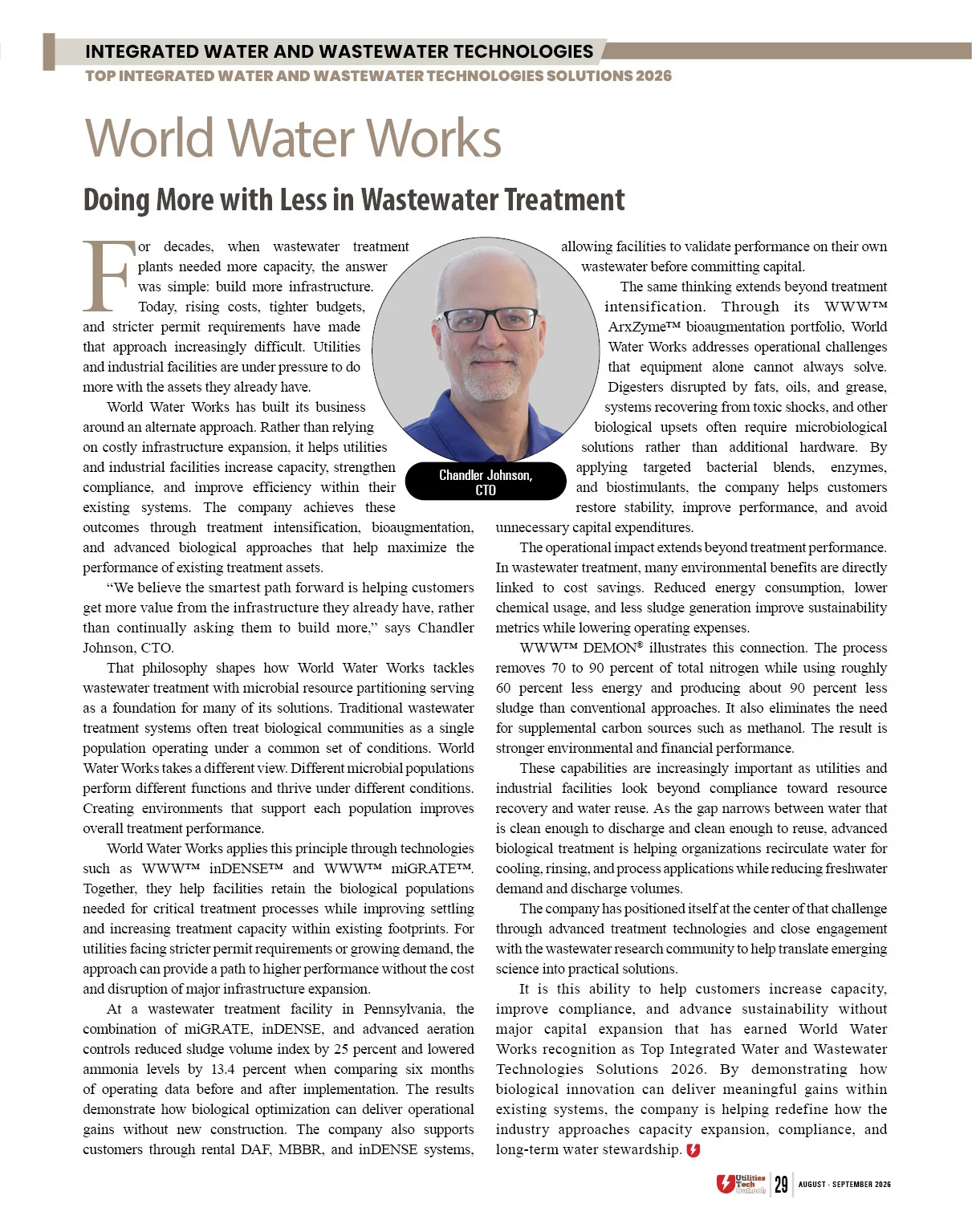
Chandler Johnson, World Water Works | Utilities Tech Outlook | Top Integrated Water and Wastewater Technologies SolutionsChandler Johnson, CTO
For decades, when wastewater treatment plants needed more capacity, the answer was simple: build more infrastructure. Today, rising costs, tighter budgets, and stricter permit requirements have made that approach increasingly difficult. Utilities and industrial facilities are under pressure to do more with the assets they already have.

World Water Works has built its business around an alternate approach. Rather than relying on costly infrastructure expansion, it helps utilities and industrial facilities increase capacity, strengthen compliance, and improve efficiency within their existing systems. The company achieves these outcomes through treatment intensification, bioaugmentation, and advanced biological approaches that help maximize the performance of existing treatment assets.

“We believe the smartest path forward is helping customers get more value from the infrastructure they already have, rather than continually asking them to build more,” says Chandler Johnson, CTO.

That philosophy shapes how World Water Works tackles wastewater treatment with microbial resource partitioning serving as a foundation for many of its solutions. Traditional wastewater treatment systems often treat biological communities as a single population operating under a common set of conditions. World Water Works takes a different view. Different microbial populations perform different functions and thrive under different conditions. Creating environments that support each population improves overall treatment performance.

World Water Works applies this principle through technologies such as WWW™ inDENSE™ and WWW™ miGRATE™. Together, they help facilities retain the biological populations needed for critical treatment processes while improving settling and increasing treatment capacity within existing footprints. For utilities facing stricter permit requirements or growing demand, the approach can provide a path to higher performance without the cost and disruption of major infrastructure expansion.
At a wastewater treatment facility in Pennsylvania, the combination of miGRATE, inDENSE, and advanced aeration controls reduced sludge volume index by 25 percent and lowered ammonia levels by 13.4 percent when comparing six months of operating data before and after implementation. The results demonstrate how biological optimization can deliver operational gains without new construction. The company also supports customers through rental DAF, MBBR, and inDENSE systems, allowing facilities to validate performance on their own wastewater before committing capital.
  • We believe the smartest path forward is helping customers get more value from the infrastructure they already have, rather than continually asking them to build more.


The same thinking extends beyond treatment intensification. Through its WWW™ ArxZyme™ bioaugmentation portfolio, World Water Works addresses operational challenges that equipment alone cannot always solve. Digesters disrupted by fats, oils, and grease, systems recovering from toxic shocks, and other biological upsets often require microbiological solutions rather than additional hardware. By applying targeted bacterial blends, enzymes, and biostimulants, the company helps customers restore stability, improve performance, and avoid unnecessary capital expenditures.

The operational impact extends beyond treatment performance. In wastewater treatment, many environmental benefits are directly linked to cost savings. Reduced energy consumption, lower chemical usage, and less sludge generation improve sustainability metrics while lowering operating expenses.

WWW™ DEMON® illustrates this connection. The process removes 70 to 90 percent of total nitrogen while using roughly 60 percent less energy and producing about 90 percent less sludge than conventional approaches. It also eliminates the need for supplemental carbon sources such as methanol. The result is stronger environmental and financial performance.

These capabilities are increasingly important as utilities and industrial facilities look beyond compliance toward resource recovery and water reuse. As the gap narrows between water that is clean enough to discharge and clean enough to reuse, advanced biological treatment is helping organizations recirculate water for cooling, rinsing, and process applications while reducing freshwater demand and discharge volumes.

The company has positioned itself at the center of that challenge through advanced treatment technologies and close engagement with the wastewater research community to help translate emerging science into practical solutions.

It is this ability to help customers increase capacity, improve compliance, and advance sustainability without major capital expansion that has earned World Water Works recognition as a Top Integrated Water and Wastewater Technologies Solutions 2026. By demonstrating how biological innovation can deliver meaningful gains within existing systems, the company is helping redefine how the industry approaches capacity expansion, compliance, and long-term water stewardship.

Deep Dive

Choosing Integrated Wastewater Technology for Capacity-Constrained Plants

Wastewater treatment has moved from a compliance backstop to a capital planning pressure point. Plants face tighter nutrient limits, uneven industrial loads, water scarcity and closer scrutiny of energy use. Many facilities must improve performance without land, long shutdowns or new concrete. For municipal utilities, the risk appears in permit exposure, sludge burden, odor complaints and deferred growth. For industrial operators, it appears in production limits, freshwater dependence, discharge cost and treatment variability. Acquiring integrated water and wastewater technology is now a decision about how much capacity, control and cost certainty an organization can draw from existing assets. The strongest solutions begin with the wastewater and the permit, then work backward to the treatment process. Flow, contaminant mix, available footprint and reuse target should shape technology selection before equipment preferences enter the discussion. This matters because no single plant problem has a universal answer. A food processor handling fats, oils, grease and organic load has different needs from a municipal utility facing ammonia limits or an industrial site managing salinity, suspended solids and pH swings. Executives should favor providers that can combine physical separation, biological treatment, nutrient removal and temporary testing into one fit-for-purpose design rather than forcing every challenge through one product line. Capital avoidance has become as important as treatment efficiency. The most attractive systems increase effective capacity within current basins, reduce aeration demand, lower chemical dependence and limit sludge disposal. That combination shifts wastewater economics away from expansion as the default response. A plant that can meet a tighter permit by improving biomass selection, retaining slow-growing organisms or strengthening biological recovery gains time and financial room. Life-cycle cost should carry equal weight with discharge quality, since the lowest installed price can become expensive when energy use, hauling, chemicals and downtime are counted. Reuse adds another layer to the buying decision. The gap between water clean enough to discharge and water reliable enough to recirculate is narrowing, especially for facilities under freshwater pressure. Advanced biological treatment, nutrient control, solids management and process monitoring now support cooling, rinsing, cleaning and process water loops in ways that can reduce intake and discharge volume. The right partner should help executives see wastewater not as a standalone compliance expense but as an asset-management question tied to capacity, cost exposure, resource recovery and future permit pressure. Scale also matters because treatment trains often move from pilot confidence to long-term capital commitment. Technology providers that can test on actual wastewater, adjust the configuration and repeat the result across different flows give buyers a clearer path from technical proof to board-level approval. That path is especially important when permit deadlines, production continuity and public accountability leave little room for speculative design. World Water Works stands out as the premier choice for organizations that need integrated treatment gains without defaulting to major construction. Its portfolio aligns closely with the pressure points that define modern wastewater decisions, with WWW™ inDENSE™ and WWW™ miGRATE adding capacity inside existing basins. WWW™ DEMON® targets energy-efficient nitrogen removal, WWW™ ArxZyme™ addresses biological upsets through bioaugmentation and WWW™ DAF and WWW™ MBBR support industrial separation and biological treatment needs. Its rental options further reduce buying risk by letting clients test configurations on actual wastewater before committing capital. ...Read more

Integrated Water and Wastewater Technology Solutions Info

Q1

What Do Integrated Water and Wastewater Technologies Solutions Companies Provide?

Integrated Water and Wastewater Technologies Solutions Companies develop complete treatment systems that help industrial and municipal organizations manage wastewater while meeting environmental requirements. Their capabilities often include process engineering, biological treatment technologies, dissolved air flotation, nutrient removal, sludge management, system integration and ongoing operational support. Bringing these processes together helps facilities improve treatment performance while supporting reliable day-to-day operations.

Q2

How Does World Water Works Stand Out Among Integrated Water and Wastewater Technologies Solutions Companies?

World Water Works stands out among Integrated Water and Wastewater Technologies Solutions Companies through its customized engineering approach and portfolio of proprietary treatment technologies. Founded in 1998, the company designs, manufactures and delivers integrated wastewater treatment systems for industrial and municipal applications. Its technologies include MBBR, IFAS, DAF, BIOCOS®, DEMON® and inDENSE®, while its fully integrated manufacturing facility gives it greater control over product quality, project schedules and system delivery.

Q3

What Should Organizations Look for When Choosing Integrated Water and Wastewater Technologies Solutions Companies?

When evaluating Integrated Water and Wastewater Technologies Solutions Companies, organizations should consider engineering expertise, technology flexibility, regulatory compliance, scalability and lifecycle costs. The ability to combine multiple treatment processes into one coordinated system is equally important, particularly for facilities with complex wastewater requirements. A solution tailored to the specific treatment challenge often delivers stronger long-term performance.

Q4

Why Are Integrated Water and Wastewater Technologies Important for Modern Treatment Facilities?

Modern treatment facilities rely on Integrated Water and Wastewater Technologies Solutions Companies to connect multiple treatment stages into a coordinated process rather than managing each one separately. An integrated approach can improve nutrient removal, increase treatment capacity, enhance effluent quality and reduce operating costs. It also helps facilities adapt more effectively as regulatory and environmental requirements continue to change.

Q5

How Does World Water Works Support Industrial and Municipal Water Treatment?

World Water Works delivers Integrated Water and Wastewater Technologies Solutions Companies capabilities through customized process design, advanced biological treatment technologies and complete project execution. The company serves industries including food and beverage, manufacturing, mining, pulp and paper and municipal utilities. Its integrated treatment systems help customers upgrade existing infrastructure, improve throughput and meet regulatory requirements more efficiently.

Q6

How Are Integrated Water and Wastewater Technologies Solutions Companies Evolving?

Today's Integrated Water and Wastewater Technologies Solutions Companies continue advancing through process intensification, automation, intelligent controls, biological treatment innovations and sustainable engineering practices. These developments help organizations improve operational efficiency, reduce energy and chemical use and maintain reliable wastewater treatment while supporting long-term environmental stewardship.
Top Integrated Water and Wastewater Technologies Solutions 2026

Company
World Water Works

Management
Chandler Johnson, CTO

Description
World Water Works develops integrated wastewater treatment solutions that help municipal and industrial customers increase treatment capacity, improve compliance, and reduce operating costs. Through advanced biological treatment, process intensification, and bioaugmentation technologies, the company enables greater performance and sustainability without major infrastructure expansion.

I agree We use cookies on this website to enhance your user experience. By clicking any link on this page you are giving your consent for us to set cookies. More info

Utilities Tech Outlook
Follow on LinkedIn

About

  • Home
  • About Us
  • Partner With Us

Stay Connected

  • Subscribe
  • Newsletter
  • Sitemap

Contact Us

  • editor@utilitiestechoutlook.com
  • sales@utilitiestechoutlook.com
  • marketing@utilitiestechoutlook.com

Legal

  • Editorial Policy
  • Privacy Policy
  • Terms of Use

© 2026 Utilities Tech Outlook. All rights reserved. Headquartered in Fort Lauderdale, FL, USA.

This content is copyright protected

However, if you would like to share the information in this article, you may use the link below:

www.utilitiestechoutlook.com/world-water-works-2026