Utilities Tech Outlook Weekly Brief
Be first to read the latest tech news, Industry Leader's Insights, and CIO interviews of medium and large enterprises exclusively from Utilities Tech Outlook
Since 1987, QB Fabrication & Welding has been a prominent utility supplier, specializing in the production of steel structures for transmission and substations. The company’s inception involved addressing emergency projects for federal, state, local, and prime contractors within the utility industry. Acknowledging the imperative for dependable power during community emergencies, the company has steadfastly maintained this commitment, ultimately growing into the premier manufacturer of steel lattice towers in the Northwest. QB Fabrication’s influence extends beyond its origin, taking on projects spanning from Canada to the city of San Francisco, where it excels in the manufacturing of custom-tailored substation structures and distribution components. As a utility supplier strategically positioned to support the Western grid from the Pacific to the Rocky Mountains states, the company emphasizes maintaining robust relationships with suppliers, crucial for ensuring on-time delivery. With a commendable 20-year association with the Bonneville Power Administration, QB Fabrication has consistently exceeded expectations in delivering high-quality products. QB Fabrication has proactively engaged with state authorities to support training programs and educational initiatives to mitigate the challenge of attracting passionate and skilled individuals to the industry in response to the shifting landscape of the post-pandemic workforce. However, the challenge persists, exacerbated by the nationwide goal of achieving 100 percent clean energy by 2035. While clients express enthusiasm for the industry’s future, the demand for expanding and upgrading transmission lines within an aggressive timeline poses a formidable task for all stakeholders. QB Fabrication has effectively addressed the domino effect impacting suppliers by undergoing a substantial transformation. This includes an 81 percent increase in manpower, the implementation of dual sourcing, the adoption of new equ
The latest advancements in wastewater treatment technologies are crucial for efficiently managing substantial volumes of wastewater prior to reintroduction into the environment. Industrial and municipal wastewater treatment demands in the wake of increased production capacity, increased population growth and tighter effluent requirements are in constant pursuit of sustainable treatment solutions, highlighting the need for cost-effective process intensification strategies. World Water Works is an emblem of customer-centric innovation, delivering tailored and result-driven wastewater treatment solutions. With 25 years of expertise in wastewater treatment, World Water Works offers customized process intensification technologies to address the most pressing wastewater challenges faced by industrial and municipal clients. The company efficiently uses or upgrades the existing infrastructure to minimize the overall project costs while increasing the capacity of the treatment facility. This versatile approach enables clients to “Do more, In less, With less .”Intensification is like treating 10 gallons of wastewater in a volume which used to treat only five gallons of water. “We bring innovation to the industry with our novel technologies delivering superior effluent quality while using less infrastructure and consumables (energy / chemicals),” says Chandler Johnson, chief technology officer at World Water Works. Whether it is a municipal facility seeking a single process to integrate or a factory requiring a full-scope solution, the company delivers the pinnacle of excellence. For industrial wastewater treatment applications, World Water Works seamlessly incorporates a range of cutting-edge technologies to deliver holistic treatment solutions, ensuring adherence to precise effluent requirements before reintroducing the treated water into the environment. Enhancing treatment efficiency, its dissolved air flotation system, WWW DAF, plays a crucial role in eliminating fats, oils, grease, and total suspended solids. Its moving bed biofilm reactor technology, WWW MBBR, facilitates biological oxygen demand (BOD) removal, nitrification, and/or denitrification. It also uses a multi-disk screw press for solid processing and sludge dewatering to reduce the volume of sludge having to be disposed of.


From a high vantage point overlooking the city, it’s clear how much effort goes into ensuring water reaches every household. Yet, as you observe the intricate network, a thought arises - millions of gallons flow through the domestic water system only to be discarded at the end as waste. What if, instead of wasting this precious resource, there was a way to recycle, reclaim and reUse it, ultimately preserving water for future generations? reUse is a wastewater treatment company that recognizes this issue and offers a groundbreaking solution. The company’s advanced MBR treatment systems are designed to produce high quality effluent suitable for a range of applications, including non-potable uses like irrigation of public parks, school yards, athletic fields, residential lawns, firefighting activities and much more. Its technology also opens pathways for both indirect and direct potable reuse, providing communities and developers with flexible, sustainable water reuse options. Technology Empowering a Sustainable World The foundation of reUse’s approach lies in its advanced Membrane Bioreactor (MBR) System, a solution that combines advanced biological processes with state-of-the-art membrane filtration. At the core of this system is the A3 MaxFlow rigid-plate membrane, featuring ultra-fine pores (absolute 0.038 microns), blocking pathogens and suspended solids, and ensuring exceptional filtration. Paired with a robust BNR (Biological Nutrient Removal) process, the System efficiently degrades organics and effectively reduces nitrogen and phosphorus, producing the highest quality effluent in the industry, making it ideal for diverse applications. Setting a New Standard of Design Beyond it’s consistently clean effluent, the System is completely turning conventional design concepts upside down, no longer relying on large and complex designs. “Our MBR System eliminates the need for conventional components like clarifiers, oversized aerobic basins, chlorine contact chambers, and sludge digesters,” explains Randall Nelson, C.O.O & Founding Member. “This reduces the plant’s footprint by 40-50%, offering a more efficient and sustainable solution for municipalities and developments with space constraints.” Not only does the System significantly reduce the overall process footprint and complexity, it also greatly reduces onsite construction. All equipment is manufactured, pre-assembled onto equipment skids, prewired and pre-plumbed before being delivered to the site for final installation costs - reducing onsite labor costs by as much as 80% over conventional plants. Further, every system undergoes rigorous testing and review to ensure that it meets industry standards and also has the flexibility to adapt to future growth. While the System’s core process and membranes have remained consistent for over 16 years, reUse is continuously refining each new system to ensure it meets the most stringent environmental, operational and effluent capabilities. “Our compact, simplified design and reduced labor requirements deliver significant savings and a quicker ROI,” adds Gaby Bolaños, V.P. of Sales & Marketing. “This makes our systems especially attractive to land developers, municipalities and utility companies seeking reliable and cost-effective solutions.” A Client-Centered Approach to Turnkey Solutions The company offers a full turn- key solution and manages every aspect of the project, including planning, designing, regulation, construction and system installation while also providing operational support as needed.

Charles Heino, Vice President Operations, EOM Operations

Amy Carstens, Director, Transmission Services, Dairyland Power Cooperative

Sean K. Sullivan, Senior Director - Clean Energy Policy, Avangrid
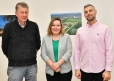
Jaša Žižek Fuis, Product Manager, Wastewater Treatment & Andreja Peternelj,

Katie L. Morgan, PWS, EP, Director of Natural and Cultural Resources at Partner Engineering & Science

Advanced treatment technologies are another critical trend shaping the future of wastewater management.

Amid growing global demand for clean water, emerging technologies are revolutionizing wastewater treatment by tackling environmental challenges and enhancing resource recovery.
The New Horizon of Wastewater Treatment Solutions
The global wastewater treatment market, valued at $346.41 billion in 2024, is expected to reach $617.81 billion by 2032. This growth is fueled by the increased adoption of membrane technologies and smart water management systems. Technologies like microbial fuel cells and thermal hydrolysis are proven to be highly successful in separating and processing wastewater, while IoT sensors can help provide valuable data.
Microbial fuel cell technology, which leverages microbes to treat wastewater, can simultaneously perform multiple functions, including clean power generation and energy storage. The bacteria’s digestion of wastewater sludge also produces charged electrons that can be used to generate electricity. Employing hydrolysis technology can essentially help in biogas generation and waste-side product minimization.
IoT systems are taking center stage in determining water quality and identifying pollutants through sensor monitoring capabilities. A critical component of asset management systems is how they help detect hazardous chemicals in the water. Technologies like these are poised to power the growth of the industrial sector in the coming years, helping organizations stay ahead of the curve in their sustainability efforts and business expansions.
In this edition of Utilities Tech Outlook, we explore recent developments in wastewater treatment solutions and how companies are employing the most advanced solutions to prevent water contamination from becoming a larger concern in the future.
We feature insights from industry experts like Julian Kaufmann, senior vice president at CAMS, who shares insights on the multifaceted developments of different energy verticals that turbocharge organizations’ net zero goals. We also feature Amy Carstens, Director, Corporate Strategy, Planning & Analysis at Dairyland Power Cooperative, who discusses the role of renewable energy generation in transmission systems.
Through this edition, we aim to help you find the right partner for your business requirements.
Let us know your thoughts!